Right-angled triangle definitions[edit]
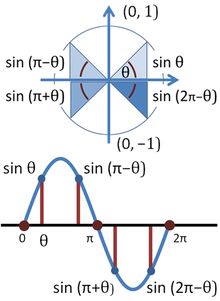
(Top): Trigonometric function sin
θfor selected angles
θ,
π −
θ,
π +
θ, and 2
π −
θ in the four quadrants. (Bottom) Graph of sine function versus angle. Angles from the top panel are identified.
The notion that there should be some standard correspondence between the lengths of the sides of a triangle and the angles of the triangle comes as soon as one recognizes that
similar triangles maintain the same ratios between their sides. That is, for any similar triangle the ratio of the
hypotenuse (for example) and another of the sides remains the same. If the hypotenuse is twice as long, so are the sides. It is these ratios that the trigonometric functions express.
To define the trigonometric functions for the angle
A, start with any
right triangle that contains the angle
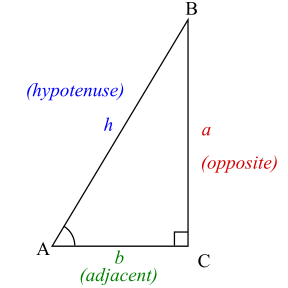
A. The three sides of the triangle are named as follows:
- The hypotenuse is the side opposite the right angle, in this case side h. The hypotenuse is always the longest side of a right-angled triangle.
- The opposite side is the side opposite to the angle we are interested in (angle A), in this case side a.
- The adjacent side is the side having both the angles of interest (angle A and right-angle C), in this case side b.
In ordinary
Euclidean geometry, according to the
triangle postulate, the inside angles of every triangle total 180
° (π
radians). Therefore, in a right-angled triangle, the two non-right angles total 90° (π/2 radians), so each of these angles must be in the range of (0°,90°) as expressed in interval notation. The following definitions apply to angles in this 0° – 90° range. They can be extended to the full set of real arguments by using the
unit circle, or by requiring certain symmetries and that they be
periodic functions. For example, the figure shows sin
θ for angles
θ,
π −
θ,
π +
θ, and 2
π −
θ depicted on the unit circle (top) and as a graph (bottom). The value of the sine repeats itself apart from sign in all four quadrants, and if the range of
θ is extended to additional rotations, this behavior repeats periodically with a period 2
π.
The trigonometric functions are summarized in the following table and described in more detail below. The angle θ is the angle between the hypotenuse and the adjacent line – the angle at A in the accompanying diagram.
| Function | Abbreviation | Description | Identities (using radians) |
|---|
| sine | sin | opposite / hypotenuse |  |
|---|
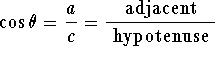
| cosine | cos | adjacent / hypotenuse |  |
|---|
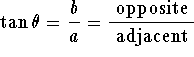
| tangent | tan (or tg) | opposite / adjacent |  |
|---|
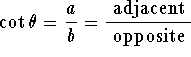
| cotangent | cot (or cotan or cotg or ctg or ctn) | adjacent / opposite |  |
|---|
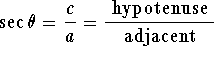
| secant | sec | hypotenuse / adjacent |  |
|---|
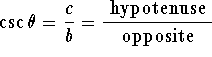
| cosecant | csc (or cosec) | hypotenuse / opposite |  |
|---|

The sine, tangent, and secant functions of an angle constructed geometrically in terms of a unit circle. The number
θ is the length of the curve; thus angles are being measured in
radians. The secant and tangent functions rely on a fixed vertical line and the sine function on a moving vertical line. ("Fixed" in this context means not moving as
θ changes; "moving" means depending on
θ.) Thus, as
θ goes from 0 up to a right angle, sin
θ goes from 0 to 1, tan
θgoes from 0 to ∞, and sec
θ goes from 1 to ∞.

The cosine, cotangent, and cosecant functions of an angle
θ constructed geometrically in terms of a unit circle. The functions whose names have the prefix
co-use horizontal lines where the others use vertical lines.
Sine, cosine and tangent [edit]
The
sine of an angle is the ratio of the length of the opposite
side to the length of the hypotenuse. (The word comes from the Latin
sinus for gulf or bay,
[1] since, given a unit circle, it is the side of the triangle on which the angle
opens.) In our case

This ratio does not depend on the size of the particular right triangle chosen, as long as it contains the angle
A, since all such triangles are
similar.
The
cosine of an angle is the ratio of the length of the adjacent side to the length of the hypotenuse: so called because it is the sine of the complementary or co-angle.
[2] In our case

The
tangent of an angle is the ratio of the length of the opposite side to the length of the adjacent side: so called because it can be represented as a line segment tangent to the circle, that is the line that touches the circle, from Latin
linea tangens or touching line (cf.
tangere, to touch).
[3] In our case

Reciprocal functions[edit]
The remaining three functions are best defined using the above three functions.
The
cosecant csc(
A), or cosec(
A), is the
reciprocal of sin(
A); i.e. the ratio of the length of the hypotenuse to the length of the opposite side:

The
secant sec(
A) is the
reciprocal of cos(
A); i.e. the ratio of the length of the hypotenuse to the length of the adjacent side:

It is so called because it represents the line that
cuts the circle (from Latin:
secare, to cut).
[4]
The
cotangent cot(
A) is the
reciprocal of tan(
A); i.e. the ratio of the length of the adjacent side to the length of the opposite side:

Slope definitions[edit]
Equivalent to the right-triangle definitions, the trigonometric functions can also be defined in terms of the
rise,
run, and
slope of a line segment relative to horizontal. The slope is commonly taught as "rise over run" or
rise⁄run. The three main trigonometric functions are commonly taught in the order sine, cosine, tangent. With a line segment length of 1 (as in a
unit circle), the following
mnemonic devices show the correspondence of definitions:
- "Sine is first, rise is first" meaning that Sine takes the angle of the line segment and tells its vertical rise when the length of the line is 1.
- "Cosine is second, run is second" meaning that Cosine takes the angle of the line segment and tells its horizontal run when the length of the line is 1.
- "Tangent combines the rise and run" meaning that Tangent takes the angle of the line segment and tells its slope; or alternatively, tells the vertical rise when the line segment's horizontal run is 1.
This shows the main use of tangent and arctangent: converting between the two ways of telling the slant of a line, i.e.,angles and slopes. (The arctangent or "inverse tangent" is not to be confused with the cotangent, which is cosine divided by sine.)
While the length of the line segment makes no difference for the slope (the slope does not depend on the length of the slanted line), it does affect rise and run. To adjust and find the actual rise and run when the line does not have a length of 1, just multiply the sine and cosine by the line length. For instance, if the line segment has length 5, the run at an angle of 7° is 5 cos(7°)
Unit-circle definitions[edit]

Signs of trigonometric functions in each quadrant. The mnemonic "
AllScience
Teachers (are)
Crazy" lists the functions which are positive from quadrants I to IV.
[5] This is a variation on the mnemonic "
All Students Take Calculus".
The six trigonometric functions can also be defined in terms of the
unit circle, the
circle of radius one centered at the origin. The unit circle definition provides little in the way of practical calculation; indeed it relies on right triangles for most angles.
The unit circle definition does, however, permit the definition of the trigonometric functions for all positive and negative arguments, not just for angles between 0 and π/2
radians.
It also provides a single visual picture that encapsulates at once all the important triangles. From the
Pythagorean theorem the equation for the unit circle is:

In the picture, some common angles, measured in radians, are given. Measurements in the counterclockwise direction are positive angles and measurements in the clockwise direction are negative angles.
Let a line through the origin, making an angle of θ with the positive half of the x-axis, intersect the unit circle. The x- and y-coordinates of this point of intersection are equal to cos θ and sin θ, respectively.
The triangle in the graphic enforces the formula; the radius is equal to the hypotenuse and has length 1, so we have sin θ = y/1 and cos θ = x/1. The unit circle can be thought of as a way of looking at an infinite number of triangles by varying the lengths of their legs but keeping the lengths of their hypotenuses equal to 1.
These values (sin 0°, sin 30°, sin 45°, sin 60° and sin 90°) can be expressed in the form

but the angles are not equally spaced.
The values for 15°, 18°, 36°, 54°, 72°, and 75° are derived as follows:


From these, the values for all multiples of 3° can be analytically computed. For example:


Though a complex task, the analytical expression of sin 1° can be obtained by analytically solving the
cubic equation
from whose solution one can analytically derive trigonometric functions of all angles of integer degrees.

The sine and cosine functions graphed on the Cartesian plane.
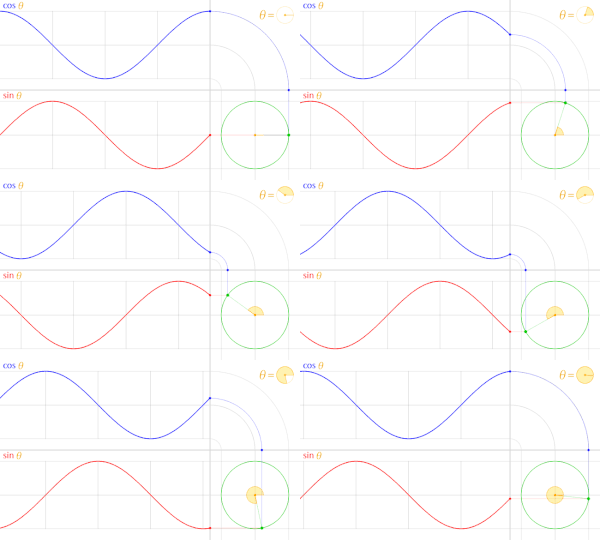
Animation showing the relationship between the unit circle and the sine and cosine functions.
For angles greater than 2π or less than −2π, simply continue to rotate around the circle; sine and cosine are
periodic functions with period 2π:


The smallest positive period of a periodic function is called theprimitive period of the function.
The primitive period of the sine or cosine is a full circle, i.e. 2π radians or 360 degrees.
Above, only sine and cosine were defined directly by the unit circle, but other trigonometric functions can be defined by:

So :
- The primitive period of the secant, or cosecant is also a full circle, i.e. 2π radians or 360 degrees.
- The primitive period of the tangent or cotangent is only a half-circle, i.e. π radians or 180 degrees.

Trigonometric functions:
Sine,
Cosine,
Tangent,
Cosecant (dotted),
Secant (dotted),
Cotangent (dotted)
The image at right includes a graph of the tangent function.
- Its θ-intercepts correspond to those of sin(θ) while its undefined values correspond to the θ-intercepts of cos(θ).
- The function changes slowly around angles of kπ, but changes rapidly at angles close to (k + 1/2)π.
- The graph of the tangent function also has a vertical asymptoteat θ = (k + 1/2)π, the θ-intercepts of the cosine function, because the function approaches infinity as θ approaches (k + 1/2)π from the left and minus infinity as it approaches (k + 1/2)π from the right.

All of the trigonometric functions of the angle
θ can be constructed geometrically in terms of a unit circle centered at
O.
Alternatively, all of the basic trigonometric functions can be defined in terms of a unit circle centered at O (as shown in the picture to the right), and similar such geometric definitions were used historically.
- In particular, for a chord AB of the circle, where θ is half of the subtended angle, sin(θ) is AC (half of the chord), a definition introduced in India[6] (see history).
- cos(θ) is the horizontal distance OC, and versin(θ) = 1 − cos(θ) is CD.
- tan(θ) is the length of the segment AE of the tangent line through A, hence the word tangent for this function. cot(θ) is another tangent segment, AF.
- sec(θ) = OE and csc(θ) = OF are segments of secant lines(intersecting the circle at two points), and can also be viewed as projections of OA along the tangent at A to the horizontal and vertical axes, respectively.
- DE is exsec(θ) = sec(θ) − 1 (the portion of the secant outside, orex, the circle).
- From these constructions, it is easy to see that the secant and tangent functions diverge as θ approaches π/2 (90 degrees) and that the cosecant and cotangent diverge as θ approaches zero.
For the angle

pictured in the figure, we see that
There are a few angles for which all trigonometric functions may be found using the triangles shown in the following Figure 2.
 |
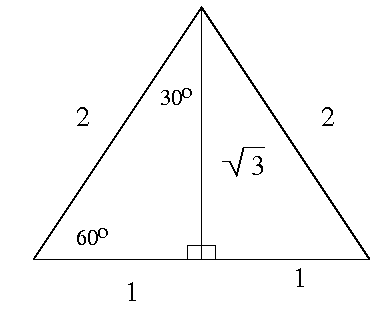 |
| Figure 2 |
This list may be extended with the use of reference angles (see Example 2 below).
EXAMPLE 1: Find the values of all trigonometric functions of the angle

.
Solution: From Figure 2, we see that the angle of

corresponds to the point

on the unit circle, and so
EXAMPLE 2: Find the values of all trigonometric functions of the angle

.
Solution: Observe that an angle of

is equivalent to 8 whole revolutions (a total of

) plus

, Hence the angles
and
intersect the unit circle at the same point
Q(
x,
y), and so their trigonometric functions are the same. Furthermore, the angle of
makes an angle of
with respect to the x-axis (in the second quadrant). From this we can see that

and hence that
We call the auxiliary angle of
the
reference angle of
.
EXAMPLE 3 Find all trigonometric functions of an angle
in the third quadrant for which

.
Solution: We first construct a point
R(
x,
y) on the terminal side of the angle
, in the third quadrant. If
R(
x,
y) is such a point, then

and we see that we may take
x=-5 and
R=6. Since

we find that

(the negative signs on
x and
y are taken so that
R(
x,
y) is a point on the third quadrant, see Figure 3).
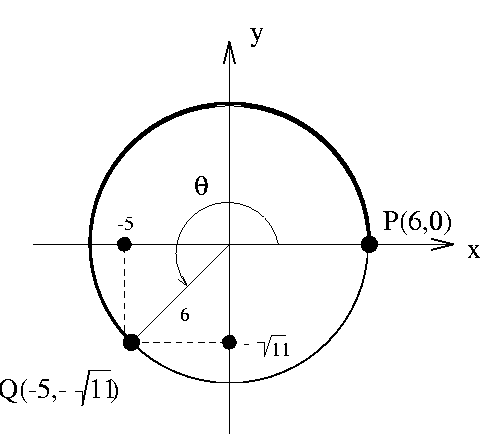 |
| Figure 3 |
It follows that
Here are some Exercises on the evaluation of trigonometric functions.
ASSESSMENT
-
| Name _____________________________ |
|  | Date ___________________ |
Trigonometry
(Answer ID # 0241143)
Complete. Round to the nearest hundredth.
| 1. | Find cos U
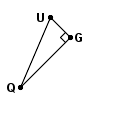
 |
| QG |
| = | 14.2 |
|
| GU |
| = | 5.6 |
|
| QU |
| = | 15.26 |
|
|
| 2. | Find tan B
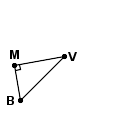
|
| BM |
| = | 3.6 |
|
| VM |
| = | 5.1 |
|
| BV |
| = | 6.24 |
|
|
| 3. | Find sin T
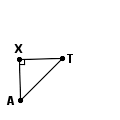
|
| AT |
| = | 0.41 |
|
| AX |
| = | 0.28 |
|
| TX |
| = | 0.3 |
|
|
| 4. | Find sin T
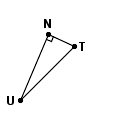
|
| UT |
| = | 8.62 |
|
| UN |
| = | 8 |
|
| TN |
| = | 3.2 |
|
|
| 5. | Find cos Y
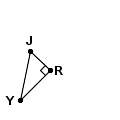
|
| YJ |
| = | 4.55 |
|
| YR |
| = | 3.8 |
|
| RJ |
| = | 2.5 |
|
|
| 6. | Find tan R
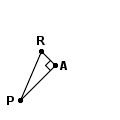
|
| PA |
| = | 0.76 |
|
| AR |
| = | 2.5 |
|
| PR |
| = | 2.61 |
|
|
| 7. | Find tan Y
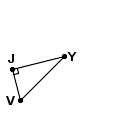
|
| VY |
| = | 20.94 |
|
| VJ |
| = | 10.7 |
|
| YJ |
| = | 18 |
|
|
| 8. | Find cos R
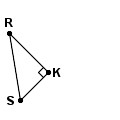
|
| KR |
| = | 27.5 |
|
| SR |
| = | 29.26 |
|
| SK |
| = | 10 |
|
|
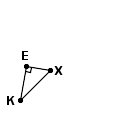
| 9. | Find sin X
|
| KX |
| = | 4.12 |
|
| KE |
| = | 0.97 |
|
| XE |
| = | 4 |
|
|
 The notion that there should be some standard correspondence between the lengths of the sides of a triangle and the angles of the triangle comes as soon as one recognizes that similar triangles maintain the same ratios between their sides. That is, for any similar triangle the ratio of thehypotenuse (for example) and another of the sides remains the same. If the hypotenuse is twice as long, so are the sides. It is these ratios that the trigonometric functions express.
To define the trigonometric functions for the angle A, start with any right triangle that contains the angle A. The three sides of the triangle are named as follows:
The notion that there should be some standard correspondence between the lengths of the sides of a triangle and the angles of the triangle comes as soon as one recognizes that similar triangles maintain the same ratios between their sides. That is, for any similar triangle the ratio of thehypotenuse (for example) and another of the sides remains the same. If the hypotenuse is twice as long, so are the sides. It is these ratios that the trigonometric functions express.
To define the trigonometric functions for the angle A, start with any right triangle that contains the angle A. The three sides of the triangle are named as follows:


 EXAMPLE 2: Find the values of all trigonometric functions of the angle
  We call the auxiliary angle of
  Here are some Exercises on the evaluation of trigonometric functions.


